


Nvidia China Orders Hit $35B — But Can It Ship Them?
Nvidia reportedly has roughly $35 billion in China orders, but it may be able to supply only a small fraction of the requested graphics cards. The real test now is whether massive demand can turn into actual shipments as samples begin in December and commercial deliveries approach next year.
October 20, 2026
Nvidia Has $35 Billion in China Orders — But May Ship Only 10%
Nvidia reportedly has roughly $35 billion in demand from Chinese technology companies, but it may supply only 5% to 10% of requested graphics cards. ByteDance, Alibaba, and Tencent have ordered more than three million RTX PRO 5500 cards. The critical distinction for investors: orders demonstrate demand, but only fulfilled deliveries can translate into sales.
Watch Today's Market Breakdown
Understand why Nvidia's enormous China order book may not translate into comparable shipments, and why the delivery schedule matters next.
Today's Market Setup
The story is not simply that China wants more Nvidia hardware. The question is whether demand can become actual sales while supply and export constraints remain.
$35 Billion in Reported Demand
ByteDance, Alibaba, and Tencent have reportedly ordered more than three million RTX PRO 5500 graphics cards. The scale of demand highlights continued Chinese spending on Nvidia hardware.
Only 5–10% May Be Supplied
Nvidia has warned partners that requested quantities could far exceed available supply. Export controls, manufacturing capacity, and product priorities influence how many cards ultimately reach buyers.
Delivery Is the Next Test
Early samples are expected in December, with commercial shipments beginning in the first quarter of 2027. Actual deliveries will provide a clearer picture of how demand becomes sales.
What Matters From Here
The demand signal is significant. The uncertainty surrounds supply, delivery timing, and eventual revenue.
- How much of the reported $35 billion in demand becomes delivered product?
- Can Nvidia increase supply beyond the initially indicated 5–10% of requested quantities?
- Will December samples and first-quarter shipments demonstrate that deliveries are progressing?
The Headlines Are Only the First Step
The free Market Preview explains why Nvidia's reported demand matters. The members-only Daily Market Brief goes deeper into the delivery milestones, constraints, confirmation signals, and risks worth monitoring as the story develops.
See What Members GetInside Today's Members-Only Daily Market Brief
- The delivery developments that could validate Nvidia's reported China demand.
- How export restrictions and manufacturing constraints affect the shipment outlook.
- What to monitor as samples are expected in December and commercial deliveries approach.
- How to distinguish a large reported order pipeline from revenue that has actually materialized.
Go Beyond the Headlines
A $35 billion order headline tells investors that demand exists. It does not establish how much hardware can ship, when buyers will receive it, or how much revenue Nvidia can recognize. The Generational Wealth Community focuses on the developments that matter next, the signals worth watching, and the risks that could change the market setup. We don't chase hype, we decode the market.
Unlock the Daily Market BriefEducational market research designed to help investors understand the setup — not chase headlines.
Your pathway from knowledge to legacy.
Stay Ahead of What Matters Next
Nvidia's next challenge is converting reported China demand into actual deliveries. Follow the developments that help explain what happens next.
Join the Generational Wealth Community
Oil Falls Below $100 Despite Massive Supply Risk
Oil fell back below $100 even as Gulf crude exports reportedly plunged and shipping risks intensified. The question now is whether potential Russian fuel flows can keep outweighing supply concerns—and whether WTI can stay below the $100 threshold.
October 19, 2026
Oil Falls Below $100 Despite Massive Supply Risk. Here’s Why
Oil fell back below $100 Monday even as major supply risks remained. West Texas Intermediate dropped about 2% to around $99.50 while Brent slid near $108. At the same time, Gulf crude exports reportedly fell sharply as shipping attacks intensified. The contradiction investors are watching is whether the possibility of more Russian fuel reaching global markets can continue outweighing those supply risks.
Watch Today's Market Breakdown
See why oil is falling despite severe supply concerns, what may be offsetting those risks, and why the $100 level for WTI matters next.
Today's Market Setup
The key tension is not that supply concerns disappeared. Oil is moving lower even while traders continue weighing significant disruptions against the possibility of additional fuel reaching global markets.
WTI Drops Back Below $100
West Texas Intermediate fell about 2% Monday to around $99.50, while Brent moved near $108. The decline puts the $100 level back in focus because holding below it could reduce some of the inflation pressure associated with higher energy prices.
Supply Risk Remains Severe
Gulf crude exports reportedly fell to about 8.5 million barrels a day last week from more than 20 million as shipping attacks intensified. That makes oil's decline notable because the physical supply backdrop remains under significant pressure.
Russian Fuel Changes the Equation
Traders are also weighing the possibility of more Russian fuel reaching global markets after Washington's Friday waiver of new Russia-related sanctions and tariffs. That potential additional supply is competing with the risks already affecting crude exports.
What Matters From Here
Oil's move below $100 creates a simple test: can prices remain there while major supply risks are still unresolved?
- Can WTI remain below $100 despite the sharp decline in Gulf crude exports?
- Does more Russian fuel actually reach global markets following Washington's waiver?
- If oil holds below $100, does that begin easing some of the inflation pressure tied to energy prices?
The Headlines Are Only the First Step
The free Market Preview explains why oil is falling even while supply risks remain high. The members-only Daily Market Brief goes deeper into the developments, confirmation signals and risks worth monitoring as investors determine whether the move below $100 can hold.
See What Members GetInside Today's Members-Only Daily Market Brief
- The developments that could determine whether WTI's move below $100 holds or reverses.
- What to monitor as traders balance disrupted Gulf crude exports against the possibility of additional Russian fuel supply.
- The signals that could show whether the current oil decline is becoming more durable.
- Why the direction of oil matters for the inflation backdrop if prices remain below the $100 threshold.
Go Beyond the Headlines
Oil falling below $100 explains what happened. The more important investing question is what confirms whether that move can continue while substantial supply risks remain. The Generational Wealth Community is built for investors who want to understand what deserves attention next, what could confirm the developing setup and what risks could change it. We don't chase hype, we decode the market.
Unlock the Daily Market BriefEducational market research designed to help investors understand the setup — not chase headlines.
Your pathway from knowledge to legacy.
Stay Ahead of What Matters Next
The next test is whether WTI can remain below $100 even as markets continue balancing severe supply risks against the possibility of additional Russian fuel flows.
Join the Generational Wealth Community
Microsoft AI Data Center Exit Exposes Power Bottleneck
Microsoft walked away from a planned AI data-center deal in Britain as the project faced delays and uncertainty over when sufficient grid power would arrive. The story raises a bigger question for the AI boom: what happens when demand for computing grows faster than the infrastructure needed to power it?
October 18, 2026
Microsoft Just Walked Away From an AI Data Center, and It Wasn’t the Chips
Microsoft has pulled out of an AI data-center deal at Nscale’s Loughton site in Britain after the project faced repeated delays. The bigger warning for the AI boom is electricity: grid officials reportedly indicated that enough power for the site may not arrive until the 2030s. Microsoft has not said the power delay caused its withdrawal, but the situation puts AI infrastructure constraints squarely in focus.
Watch Today's Market Breakdown
See why Microsoft’s withdrawal matters, how a planned deployment of roughly 23,000 Nvidia GB300 GPUs ran into infrastructure uncertainty, and what investors should watch next.
Today's Market Setup
The story is not that demand for AI computing suddenly disappeared. It is that building enough physical infrastructure to support that computing may be becoming a more important constraint.
Microsoft Walks Away
Microsoft pulled out of an AI data-center deal at Nscale’s Loughton site in Britain. The project had been expected to open next year and house roughly 23,000 Nvidia GB300 GPUs, making its delays notable for the broader AI infrastructure buildout.
Power Becomes the Bigger Question
Grid officials reportedly told Nscale that sufficient electricity for the site may not arrive until the 2030s. Microsoft has not said that delay caused its decision, but the situation illustrates how electricity and grid access can limit even well-funded AI projects.
Chips Alone Aren't Enough
Thousands of advanced GPUs have little value without the power and infrastructure required to operate them. That shifts part of the AI investment story beyond semiconductor availability and toward the physical systems needed to bring new computing capacity online.
What Matters From Here
Microsoft’s withdrawal raises a larger question: how often could infrastructure limitations begin determining where AI capacity actually gets built?
- Does Microsoft shift the planned computing capacity to another location with better access to electricity and infrastructure?
- Do other major cloud providers begin reconsidering projects caught in long grid-connection queues?
- Does access to power become an increasingly important factor in deciding which AI data-center projects move forward and which remain delayed?
The Headlines Are Only the First Step
The free Market Preview explains why Microsoft’s withdrawal matters. The members-only Daily Market Brief goes deeper into the infrastructure signals, developing risks and confirmation points worth monitoring as investors determine whether power constraints are becoming a broader issue for the AI buildout.
See What Members GetInside Today's Members-Only Daily Market Brief
- The developments that could show whether the Loughton situation is isolated or part of a broader AI infrastructure constraint.
- What Microsoft does with the capacity it had planned for the project and whether that investment shifts elsewhere.
- The grid and infrastructure signals that could become increasingly important as cloud companies expand AI computing capacity.
- Why investors should separate strong demand for advanced chips from the practical ability to power and operate the data centers that use them.
Go Beyond the Headlines
Microsoft’s decision illustrates why the next phase of the AI boom may depend on much more than chips. Electricity, grid access and infrastructure can determine whether enormous computing projects actually become operational. The Generational Wealth Community is built for investors who want to understand what deserves attention next, what could confirm the developing story and what risks could change the setup. We don't chase hype, we decode the market.
Unlock the Daily Market BriefEducational market research designed to help investors understand the setup — not chase headlines.
Your pathway from knowledge to legacy.
Stay Ahead of What Matters Next
The next signal is whether Microsoft moves this computing capacity elsewhere — and whether other major AI projects begin running into the same infrastructure problem.
Join the Generational Wealth Community
Apple’s $2,000 Foldable iPhone Sells Out — Demand or Supply?
Apple’s roughly $2,000 foldable iPhone sold out within hours, but without disclosed launch inventory, the early scarcity does not yet prove blockbuster demand. The October 23 in-store launch could provide a clearer test of whether the iPhone Duo is seeing sustained consumer demand or simply a tightly constrained debut.
October 17, 2026
Apple’s $2,000 Foldable iPhone Sold Out in Hours — Real Demand or Tight Supply?
Apple’s roughly $2,000 iPhone Duo sold out within hours of Friday’s preorder launch, with online deliveries quickly slipping into late January. That is an encouraging first signal for Apple’s first foldable iPhone, but it is not yet proof of blockbuster demand. Apple has not disclosed launch inventory, leaving investors to separate genuine consumer enthusiasm from a potentially constrained initial supply.
Watch Today's Market Breakdown
See why the iPhone Duo’s rapid sellout matters — and why the October 23 store launch could give investors a clearer read on demand versus supply.
Today's Market Setup
The early preorder result gives Apple a strong launch headline, but the market still lacks the inventory data needed to judge the strength of demand cleanly.
Preorders Sell Out Within Hours
Apple opened preorders Friday for its first foldable iPhone, the roughly $2,000 iPhone Duo. Online availability tightened quickly, with delivery estimates moving into late January. The speed of the sellout puts immediate attention on how much demand Apple can generate for an entirely new iPhone format.
The $2,000 Price Is the Real Test
The Duo is testing whether consumers will pay a major premium for a radically different iPhone. A rapid sellout is notable, but Apple has not disclosed launch inventory, so long waits could reflect strong demand, tight supply, or some combination of both.
Apple Holds Up as the Nasdaq Falls
Apple shares finished Friday up about 0.4% while the Nasdaq fell about 2.1%. That relative performance adds to investor interest around the launch, but the more useful demand signal may come when the Duo reaches physical stores on October 23.
What Matters From Here
The sellout answers the first question — people showed up for preorders. The next step is determining how much of the scarcity reflects sustained demand versus a constrained launch.
- Does availability remain scarce after the October 23 in-store launch, or does supply begin to normalize quickly?
- Do late-January delivery estimates persist as more orders are processed, or do wait times shorten?
- Can Apple sustain demand at roughly $2,000 once the initial launch wave passes?
The Headlines Are Only the First Step
The free Market Preview explains why the Duo’s early sellout matters. The members-only Daily Market Brief goes deeper into the demand signals, availability trends, market reaction and confirmation points worth monitoring as investors get a clearer read on whether this is durable demand or launch-day scarcity.
See What Members GetInside Today's Members-Only Daily Market Brief
- The October 23 availability signals that could help separate real demand strength from a supply-constrained launch.
- Whether long delivery windows remain in place or begin improving as Apple moves beyond the initial preorder rush.
- What Apple’s stock reaction may reveal as investors receive better evidence about demand for the new foldable category.
- The risk of treating a rapid sellout as definitive demand evidence when Apple has not disclosed launch inventory.
Go Beyond the Headlines
Apple’s foldable launch shows why a headline can be important without telling the whole story. Selling out quickly matters, but inventory, availability and what happens after the first wave of buyers matter too. The Generational Wealth Community is designed for investors who want to understand what deserves attention next, what could confirm the current setup and what risks could change it. We don't chase hype, we decode the market.
Unlock the Daily Market BriefEducational market research designed to help investors understand the setup — not chase headlines.
Your pathway from knowledge to legacy.
Stay Ahead of What Matters Next
The Duo’s first sellout is a useful signal, but the October 23 store launch should offer a better test of whether demand remains strong as availability becomes clearer.
Join the Generational Wealth Community
CoreWeave Bond Yields Hit 16% — AI Debt Warning
CoreWeave’s stock is falling, but the more important warning may be coming from its debt as one bond briefly yielded above 16%. AI demand remains strong — the question now is whether rising financing pressure stays isolated or begins spreading across the AI buildout.
October 16, 2026
CoreWeave Bond Yields Hit 16% — AI’s Real Warning Is Debt
AI demand remains strong, but CoreWeave is exposing a different risk inside the artificial-intelligence buildout: financing. The Nvidia-backed cloud provider has come under pressure in both its stock and debt, with one bond briefly yielding more than 16%. The bigger question now is whether that credit stress stays contained — or becomes a warning for other heavily leveraged AI borrowers.
Watch Today's Market Breakdown
See why CoreWeave's bond market may be sending a more important warning than its falling stock — and why higher borrowing costs matter for the AI infrastructure boom.
Today's Market Setup
The AI growth story has not disappeared. The market is increasingly focused on whether companies funding that growth with large amounts of debt can keep doing so profitably when borrowing costs remain high.
CoreWeave Comes Under Pressure
CoreWeave was down more than 15% for the week through Thursday's close, with shares falling another 4% before Friday's open. The weakness puts fresh attention on an AI infrastructure company whose growth depends on financing a massive computing buildout.
Credit Markets Send the Bigger Warning
One CoreWeave bond briefly yielded more than 16%, while the cost of insuring its debt against default reached record highs. That makes this more than a stock-price story: investors are demanding greater compensation for taking CoreWeave's credit risk.
Inflation Makes Financing Harder
September producer prices jumped 1.3%, the biggest monthly increase in four and a half years. Higher inflation pressure can keep borrowing costs elevated, intensifying the question of whether heavily leveraged AI companies can finance expansion profitably.
What Matters From Here
Strong AI demand answers only part of the investment question. Credit markets are now testing the financial structure behind that growth.
- Does CoreWeave's credit stress begin to ease, or do investors continue demanding unusually high yields to hold its debt?
- Does the pressure remain specific to CoreWeave, or begin spreading to other AI companies relying heavily on borrowed capital?
- Can strong AI demand translate into profitable growth if inflation keeps financing costs elevated?
The Headlines Are Only the First Step
The free Market Preview explains why CoreWeave's credit market matters to the broader AI story. The members-only Daily Market Brief goes deeper into the risks, catalysts, confirmation signals and developments worth monitoring as investors determine whether this is an isolated credit problem or something broader.
See What Members GetInside Today's Members-Only Daily Market Brief
- The credit-market signals that could indicate whether CoreWeave's financing pressure is stabilizing or becoming more serious.
- What CoreWeave's bond yields and default-insurance costs can reveal that its stock price alone cannot.
- The developments worth monitoring for signs that credit stress is spreading to other leveraged AI borrowers.
- How persistent inflation and elevated borrowing costs could change the economics of the broader AI infrastructure buildout.
Go Beyond the Headlines
CoreWeave shows why understanding the AI boom requires looking beyond chips, revenue growth and stock prices. Financing matters too. The Generational Wealth Community is designed for investors who want to understand what deserves attention next, what could confirm the current setup and what risks could change it. We don't chase hype, we decode the market.
Unlock the Daily Market BriefEducational market research designed to help investors understand the setup — not chase headlines.
Your pathway from knowledge to legacy.
Stay Ahead of What Matters Next
AI demand remains powerful, but CoreWeave is putting the financing behind that growth under a brighter spotlight. Follow the signals that show whether this credit pressure stays isolated or begins spreading.
Join the Generational Wealth Community
AI Chip Profits Jump 69% as Rate Fears Hit AI Stocks
TSMC just posted its sixth straight record quarter, with third-quarter profit up nearly 69% and AI demand still exceeding supply. But AI stocks are falling as inflation and renewed rate fears force investors to reconsider what that growth is worth.
October 15, 2026
AI Chip Profits Jump 69% — So Why Are AI Stocks Falling?
TSMC just delivered another record quarter, with third-quarter profit up nearly 69% and AI demand still exceeding the company's supply capacity. Yet AI stocks are moving lower as hotter U.S. inflation revives concerns about higher borrowing costs. The tension is now clear: strong AI growth is colliding with a market that may demand lower valuations when money stays expensive.
Watch Today's Market Breakdown
See why record AI-chip profits are not translating into higher AI stocks, how interest-rate fears are changing the setup and why producer prices are the next major test.
Today's Market Setup
The AI growth story remains strong. The market's problem is that strong earnings and strong stocks are no longer automatically the same thing when interest-rate expectations are moving higher.
TSMC Delivers Another Record Quarter
TSMC reported third-quarter profit up nearly 69%, marking its sixth straight record quarter. The company also says AI demand remains extremely robust and continues to exceed supply capacity, reinforcing the strength of the underlying semiconductor story.
Higher-Rate Fears Hit AI Stocks
Hotter U.S. inflation pushed rate-hike concerns higher as the Nasdaq fell nearly 2% Wednesday. Nasdaq futures were down more than 1% before the bell, while Nvidia, Micron and AMD were also trading lower.
Growth Is Facing a Valuation Test
The decline does not mean AI demand suddenly disappeared. Investors are questioning what they should pay for that growth when borrowing costs stay elevated. Producer prices at 8:30 a.m. Eastern are the next major test for that debate.
What Matters From Here
Strong AI earnings have answered one question. Interest rates are now creating a different set of questions for investors.
- Does the producer-price report strengthen or weaken the market's renewed concern about higher interest rates?
- Can extremely strong AI demand offset valuation pressure if borrowing costs remain elevated?
- Does weakness in Nvidia, Micron and AMD stabilize, or does pressure on AI-related stocks continue despite strong semiconductor fundamentals?
The Headlines Are Only the First Step
The free Market Preview explains why record AI-chip profits and falling AI stocks can exist at the same time. The members-only Daily Market Brief goes deeper into the catalysts, risks, confirmation signals and developments worth monitoring as investors evaluate the interaction between AI growth and rates.
See What Members GetInside Today's Members-Only Daily Market Brief
- How the producer-price report could influence the market's renewed concern about interest rates and borrowing costs.
- What TSMC's sixth straight record quarter says about the underlying strength of AI-chip demand.
- The developments worth monitoring in Nvidia, Micron and AMD as investors weigh strong AI fundamentals against valuation pressure.
- The signals that could show whether higher rates are becoming a larger obstacle for richly valued AI stocks.
Go Beyond the Headlines
TSMC's results show that AI demand remains powerful. The harder question is how markets value that growth when inflation and borrowing costs remain a concern. The Generational Wealth Community is designed for investors who want to understand what deserves attention next, what could confirm the current setup and what risks could change it. We don't chase hype, we decode the market.
Unlock the Daily Market BriefEducational market research designed to help investors understand the setup — not chase headlines.
Your pathway from knowledge to legacy.
Stay Ahead of What Matters Next
AI demand remains strong, but interest rates are testing what investors are willing to pay for that growth. Follow the catalysts that determine which force matters most from here.
Join the Generational Wealth Community
ASML Can't Meet 2027 AI Chip Demand as Supply Tightens
ASML says its planned supply of advanced chipmaking machines will not fully meet customer demand in 2027 and 2028, even as capacity expands. With customers already discussing orders for 2029 and 2030, manufacturing equipment could become one of the AI boom's most important bottlenecks.
October 14, 2026
The AI Chip Boom Just Hit a Supply Wall — ASML Can't Meet 2027 Demand
AI chip demand is beginning to run into a different constraint: the machines required to manufacture advanced semiconductors. ASML says its planned supply for 2027 and 2028 will not fully meet customer demand, even as it prepares roughly 30% more low-NA EUV and immersion capacity for 2027. The bigger question is whether production capacity can expand fast enough to keep the AI buildout moving on schedule.
Watch Today's Market Breakdown
See why ASML's capacity limits matter to the AI chip boom, how far customer demand is extending and what investors will be watching next.
Today's Market Setup
AI demand is no longer only a question of how many chips customers want. The capacity to manufacture those chips is becoming part of the equation.
2027 and 2028 Demand Exceeds Supply
ASML says the chipmaking machines it currently plans to supply in 2027 and 2028 will not fully meet customer demand. Because its lithography systems are essential to producing advanced semiconductors, ASML's own manufacturing capacity is becoming increasingly important to the broader AI infrastructure buildout.
ASML Is Already Expanding Capacity
The company is planning roughly 30% more low-NA EUV and immersion capacity for 2027, yet says that may still fall short. That gap highlights how rapidly demand for the equipment behind advanced AI-chip production is growing.
Customers Are Looking Toward 2030
Some customers are already asking ASML about orders for 2029 and 2030. At the same time, third-quarter sales reached a record €11.7 billion and shares rose after the update, showing how far expectations for semiconductor manufacturing capacity now extend.
What Matters From Here
Demand is clearly extending well beyond the next year. The unanswered question is how quickly supply can catch up.
- Can ASML expand manufacturing capacity quickly enough to satisfy customers without delaying the broader AI buildout?
- Will the roughly 30% increase in planned 2027 low-NA EUV and immersion capacity materially narrow the gap between supply and customer demand?
- How far will customer commitments extend as companies begin discussing chipmaking-equipment requirements for 2029 and 2030?
The Headlines Are Only the First Step
The free Market Preview explains why ASML's capacity problem matters to the AI chip boom. The members-only Daily Market Brief goes deeper into the catalysts, risks and developments worth monitoring as investors evaluate whether semiconductor-equipment supply can keep pace with AI demand.
See What Members GetInside Today's Members-Only Daily Market Brief
- How to evaluate ASML's capacity expansion against customer demand stretching through 2027, 2028 and beyond.
- Why lithography-equipment availability is becoming an important constraint in the wider AI semiconductor buildout.
- What ASML's record €11.7 billion quarter suggests about the scale of demand currently reaching chip-equipment suppliers.
- The capacity developments worth monitoring as customers begin discussing requirements extending into 2029 and 2030.
Go Beyond the Headlines
Knowing that ASML cannot currently meet all projected customer demand is useful. Understanding whether capacity expansion can keep pace — and what that could mean for the broader AI infrastructure story — requires following the developments that come next. The Generational Wealth Community is built for investors who want that deeper context. We don't chase hype, we decode the market.
Unlock the Daily Market BriefEducational market research designed to help investors understand the setup — not chase headlines.
Your pathway from knowledge to legacy.
Stay Ahead of What Matters Next
AI chip demand is now testing the capacity of the equipment manufacturers behind the semiconductor supply chain. Follow whether ASML can expand fast enough to keep pace.
Join the Generational Wealth Community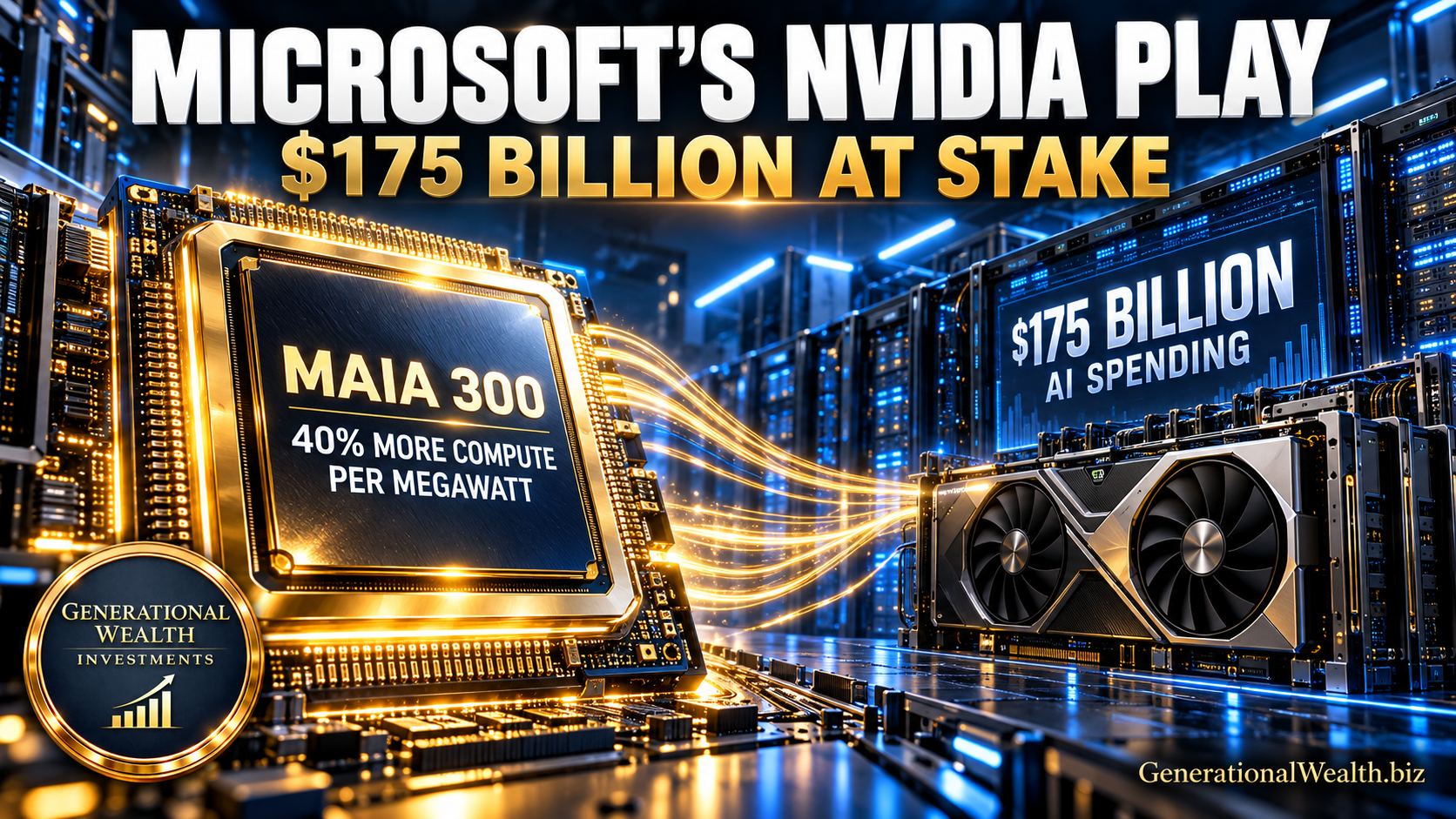
Microsoft Maia 300 Challenges Nvidia’s AI Chip Lead
Microsoft plans to deploy potentially more than one million Maia 300 chips next year as it pushes deeper into its own AI infrastructure. With more than $175 billion in expected capital spending, the bigger question is how Microsoft’s shift toward in-house silicon could change where AI money flows.
October 13, 2026
Microsoft's Maia 300 Chip Puts Nvidia on Notice — Where $175B in AI Spending Could Go
Microsoft plans to deploy potentially more than one million Maia 300 AI chips next year, making its own silicon the primary inference system for Microsoft products and services. The move matters because major cloud companies are trying to reduce their dependence on Nvidia GPUs. With Microsoft expecting more than $175 billion in capital spending this year, the bigger question is where that AI money goes if more computing moves in-house.
Watch Today's Market Breakdown
See why Microsoft's Maia 300 matters to Nvidia, how power efficiency fits into the AI infrastructure race, and what investors will be watching next.
Today's Market Setup
Maia 300 raises a broader question about who captures the enormous spending behind the AI infrastructure buildout.
More Than One Million Maia 300 Chips
Microsoft plans to deploy potentially more than one million Maia 300 chips next year. Its goal is to make its own silicon the primary inference system for Microsoft products and services, increasing the role of internally designed hardware inside its AI infrastructure.
The Efficiency Claim Matters
Microsoft says Maia 300 can deliver about 40% more useful computing per megawatt than leading GPU-based systems. That puts power efficiency directly into the competition between Microsoft's in-house chips and the GPU infrastructure that has helped make Nvidia dominant in AI.
Follow the $175 Billion
Microsoft expects more than $175 billion in capital spending this year. As more of its AI workloads potentially move toward in-house silicon, investors have a new question to consider: how much of that enormous infrastructure spending continues flowing toward outside chip suppliers?
What Matters From Here
The Maia 300 announcement establishes Microsoft's direction. The next question is how aggressively it follows through.
- How quickly can Microsoft turn a deployment of potentially more than one million Maia 300 chips into meaningful dependence on its own silicon?
- Could Microsoft's reported efficiency advantage change how it allocates its massive AI infrastructure spending?
- What additional details will Microsoft reveal at Ignite next month about Maia 300 and its broader AI computing strategy?
The Headlines Are Only the First Step
The free Market Preview explains what Microsoft announced and why Nvidia investors are paying attention. The members-only Daily Market Brief goes deeper into the catalysts, risks, competitive implications and developments worth monitoring as Microsoft expands its in-house AI infrastructure.
See What Members GetInside Today's Members-Only Daily Market Brief
- What Microsoft's planned Maia 300 deployment could mean for its long-term dependence on Nvidia GPUs.
- Why the 40% useful-computing-per-megawatt claim matters in an AI industry increasingly constrained by power.
- How Microsoft's more than $175 billion capital-spending plan frames the competition for AI infrastructure dollars.
- Why Microsoft Ignite next month becomes the next important catalyst for understanding how far the Maia strategy may go.
Go Beyond the Headlines
Knowing that Microsoft built a new AI chip is only the beginning. Investors also need to understand where capital is moving, which competitive relationships may be changing, and what developments deserve attention next. The Generational Wealth Community is built to help everyday investors develop that deeper understanding of the market. We don't chase hype, we decode the market.
Unlock the Daily Market BriefEducational market research designed to help investors understand the setup — not chase headlines.
Your pathway from knowledge to legacy.
Stay Ahead of What Matters Next
Microsoft's Maia 300 puts a new spotlight on where AI infrastructure spending could flow. Follow the developments that could clarify how much of Microsoft's AI future will be built on its own silicon.
Join the Generational Wealth Community
Amazon's $7B Decart Deal: Why AI Infrastructure Matters
Amazon is reportedly considering a $7 billion acquisition of Decart, a startup whose technology extends beyond AI video into software that operates across competing AI chip platforms. The potential deal raises bigger questions about Amazon Web Services' AI strategy, the price Amazon may ultimately pay, and whether the acquisition will happen at all.
October 12, 2026
Amazon's $7B AI Bet: Why It Wants Decart So Badly
Amazon is reportedly in talks to acquire AI startup Decart for approximately $7 billion. That's about 75% above Decart's valuation from just five months earlier. But the story goes beyond AI video generation. Decart develops technology that helps AI workloads run across Nvidia, Amazon and Google chips. The question now is whether that capability is worth such a significant premium to Amazon Web Services.
Watch Today's Market Breakdown
Learn why Amazon is interested in Decart, what its AI technology does and what could happen next.
Today's Market Setup
The reported Amazon–Decart negotiations highlight three questions about where AI infrastructure competition is heading.
A Potential $7 Billion Deal
Decart was valued near $4 billion just five months ago. Amazon's reported interest at approximately $7 billion suggests a substantial premium for the startup. However, these discussions remain preliminary and have not produced a signed acquisition agreement.
AI Software That Spans Chips
Decart isn't limited to AI video models. Its software helps AI workloads operate across Nvidia chips, Amazon Trainium and Google's TPUs. That flexibility could be strategically important as cloud providers compete for AI computing customers.
Why AWS Is Watching
Amazon Web Services competes for AI computing business. Technology that can operate across several hardware platforms could support that effort. Still, Amazon has declined to comment, and another bidder could enter the picture.
What Matters From Here
The potential price is significant. What remains uncertain is the deal's outcome and its strategic value.
- Will Amazon reach a signed acquisition agreement with Decart?
- How much of the proposed valuation reflects Decart's ability to support multiple AI chip architectures?
- Could another bidder change the terms or outcome of these negotiations?
The Headlines Are Only the First Step
The free Market Preview explains the reported transaction and its broad significance. The members-only Daily Market Brief explores the underlying questions, catalysts, risks and developments worth following as the story unfolds.
See What Members GetInside Today's Members-Only Daily Market Brief
- The strategic questions behind Amazon's reported $7 billion valuation of Decart.
- Why Decart's multi-chip technology matters to AWS.
- The competitive implications involving Nvidia, Trainium and Google's TPUs.
- Which deal developments could change the current acquisition narrative.
Go Beyond the Headlines
A potential $7 billion deal tells investors what may be happening. Understanding why it matters requires examining the technology, the competitive landscape and the unanswered questions. The Generational Wealth Community helps everyday investors develop a clearer understanding of financial markets and the developments worth monitoring. We don't chase hype, we decode the market.
Unlock the Daily Market BriefEducational market research designed to help investors understand the setup, not chase headlines.
Your pathway from knowledge to legacy.
Stay Ahead of What Matters Next
Amazon's Decart discussions are still preliminary. Follow the developments that could turn this potential acquisition into a meaningful AI infrastructure deal.
Join the Generational Wealth Community
Nvidia Wants Reflection AI: What the Deal Could Mean
Nvidia may be looking beyond its dominant position in AI chips as it discusses a possible deal with Reflection AI. The unanswered question is whether those talks become a full takeover—or a different kind of partnership that pushes Nvidia deeper into AI models.
October 11, 2026
Nvidia Wants More Than Chips: The Reflection AI Deal Explained
Nvidia is discussing a possible takeover of Reflection AI after already investing about $800 million in the startup. The bigger story is what Nvidia may be trying to become: not simply the dominant supplier of AI hardware, but a larger force in the models and technology running on those chips. The question now is what form a potential deal actually takes.
Watch Today's Market Breakdown
See why the Reflection AI talks matter, what Beam adds to the story and why Nvidia has several options besides a traditional takeover.
Today's Market Setup
Nvidia's discussions with Reflection AI point to a broader strategic question: how far the chip leader wants to expand beyond the hardware layer of artificial intelligence.
Nvidia Is Already Invested
Reflection AI was seeking a $25 billion valuation earlier this year, while Nvidia has already invested about $800 million. The companies are now discussing a possible transaction, but the talks remain early and could still fall apart.
The Strategy Goes Beyond Chips
Reflection recently launched Beam, an open-weight model built to compete with lower-cost Chinese systems including DeepSeek and Kimi. Nvidia's interest suggests its AI strategy may be expanding further into the models and technology that run on its hardware.
A Takeover Is Only One Option
Nvidia could buy Reflection outright, invest additional capital, provide more chips, or pursue an acqui-hire that brings in Reflection's talent while licensing its technology. That makes the structure of any eventual agreement as important as whether a deal happens.
What Matters From Here
The discussions reveal Nvidia's interest in moving deeper into AI models. What investors still do not know is how aggressively the company intends to pursue that expansion.
- Does Nvidia pursue a full takeover of Reflection AI, or choose a smaller investment, chip partnership or technology-licensing arrangement?
- How important are Reflection's Beam model, technical talent and intellectual property to Nvidia's broader push beyond hardware?
- Do these early discussions turn into an actual agreement in the coming weeks, or end without a transaction?
The Headlines Are Only the First Step
The free Market Preview explains why Nvidia's Reflection AI talks matter and the possible forms a transaction could take. The members-only Daily Market Brief goes deeper into the catalysts, risks, confirmation signals and developments worth monitoring as this story progresses.
See What Members GetInside Today's Members-Only Daily Market Brief
- How to evaluate whether Nvidia's interest in Reflection signals a broader strategic push into AI models rather than another conventional technology investment.
- Why the structure of a potential transaction matters when the possibilities range from a full acquisition to additional investment, chips, talent and technology licensing.
- What Reflection's Beam launch adds to the competitive picture involving lower-cost models such as DeepSeek and Kimi.
- Which developments would show that these early discussions are moving closer to an actual agreement — or beginning to lose momentum.
Go Beyond the Headlines
Knowing Nvidia is discussing a possible Reflection AI deal tells you what happened. Understanding which form the transaction could take, what it says about Nvidia's strategy beyond chips and which developments deserve continued attention requires following the story as it evolves. The Generational Wealth Community is built for investors who want that deeper context without chasing every headline. We don't chase hype, we decode the market.
Unlock the Daily Market BriefEducational market research designed to help investors understand the setup — not chase headlines.
Your pathway from knowledge to legacy. We don't chase hype, we decode the market.
Stay Ahead of What Matters Next
Nvidia's Reflection AI discussions are still early. The next question is whether they develop into a takeover, a different strategic arrangement or no transaction at all.
Join the Generational Wealth Community
AI Drives Wall Street Profits as Chip Earnings Jump 136%
AI is carrying an unusually large share of Wall Street’s expected profit growth, with semiconductor earnings projected to rise about 136%. That strength is supporting stocks near records, but it also makes the next AI earnings reports increasingly important.
October 10, 2026
AI Is Carrying Wall Street's Profits — Chip Earnings Seen Up 136%
AI is no longer just driving market enthusiasm — it is carrying a large share of expected profit growth. Analysts expect S&P 500 earnings to rise about 30% from a year ago this quarter, with roughly two-thirds of that increase coming from technology and AI heavyweights. The bigger question now is whether those profits can keep justifying the market's expectations.
Watch Today's Market Breakdown
See how concentrated Wall Street's expected earnings growth has become, why semiconductor profits matter and why TSMC's Thursday report is the next important test.
Today's Market Setup
The market's earnings story is increasingly tied to AI. Strong expected profit growth helps support stocks near records, but that concentration also means the next round of technology earnings carries more weight.
S&P 500 Profits Seen Up 30%
Analysts expect S&P 500 earnings to increase about 30% from a year ago this quarter. That headline growth helps explain continued market strength, but the gains are not expected to be spread evenly across corporate America.
AI Is Doing the Heavy Lifting
Roughly two-thirds of the expected increase is projected to come from technology and AI heavyweights including Alphabet, Amazon and Meta. That makes the market's profit growth unusually dependent on a relatively concentrated group of companies.
Chip Earnings Seen Surging 136%
Semiconductor earnings are projected to rise about 136%. That strength helps explain why stocks have remained near records even with the 10-year Treasury yield above 5% — but it also creates a high bar for upcoming results.
What Matters From Here
Strong AI earnings can support elevated market expectations. The risk is that the more investors depend on that growth, the more important each major earnings report becomes.
- Can AI-driven profit growth remain strong enough to support stocks while the 10-year Treasury yield remains above 5%?
- Will semiconductor results validate expectations for roughly 136% earnings growth, or show that investors have pushed expectations too far?
- Does Taiwan Semiconductor's Thursday report confirm continued AI-chip demand or begin to challenge one of the market's most important profit-growth assumptions?
The Headlines Are Only the First Step
The free Market Preview explains why AI is carrying such a large share of expected earnings growth. The members-only Daily Market Brief goes deeper into the catalysts, risks, confirmation signals and developments worth monitoring as the next round of AI earnings arrives.
See What Members GetInside Today's Members-Only Daily Market Brief
- How to evaluate whether AI earnings are continuing to justify the market's current expectations.
- Why the concentration of earnings growth in major technology companies matters if results begin diverging from forecasts.
- What Taiwan Semiconductor's upcoming earnings can reveal about the strength of underlying AI-chip demand.
- How the combination of strong AI profits and a 10-year Treasury yield above 5% shapes the market setup investors are now navigating.
Go Beyond the Headlines
Knowing that semiconductor earnings are expected to rise 136% is useful. Understanding whether the next results confirm that expectation — and what could change the broader market setup — requires following the story as it develops. The Generational Wealth Community is built for investors who want that deeper context without chasing every headline. We don't chase hype, we decode the market.
Unlock the Daily Market BriefEducational market research designed to help investors understand the setup — not chase headlines.
Your pathway from knowledge to legacy. We don't chase hype, we decode the market.
Stay Ahead of What Matters Next
AI is carrying an increasingly important share of Wall Street's expected profit growth. TSMC's earnings provide the next opportunity to test whether the underlying chip-demand story is keeping pace with expectations.
Join the Generational Wealth Community
SpaceX Buys $8B Spectrum; Wireless Stocks Fall 6%
SpaceX's reported $8 billion spectrum acquisition sent T-Mobile, Verizon and AT&T shares down about 6% after hours, raising questions about the future of America's wireless market. With Starlink Mobile preparing for broader competition, FCC approval is now a key development to watch.
October 9, 2026
SpaceX Buys $8B in Spectrum — T-Mobile, Verizon, AT&T Fall 6%
SpaceX agreed to buy nationwide low-band wireless spectrum for a reported $8 billion, and shares of T-Mobile, Verizon and AT&T fell about 6% in after-hours trading. The deal could help Starlink Mobile move closer to competing directly with America's established wireless carriers. The key question now is whether regulatory approval clears the way for that competition.
Watch Today's Market Breakdown
See why SpaceX's spectrum deal matters, how Starlink Mobile could challenge traditional wireless carriers and what the FCC must decide next.
Today's Market Setup
SpaceX's reported spectrum purchase is more than another satellite investment. It raises the possibility of a stronger competitor in the U.S. wireless market and shifts attention toward regulatory approval.
An $8 Billion Spectrum Deal
SpaceX agreed to acquire nationwide low-band spectrum for a reported $8 billion. These frequencies can travel farther and penetrate buildings, helping address a major technical challenge for satellite-based mobile service. The acquisition could expand Starlink Mobile's competitive capabilities.
Wireless Stocks Fall 6%
T-Mobile, Verizon and AT&T each fell about 6% in after-hours trading. Investors are weighing what a stronger Starlink Mobile service could mean for established wireless carriers and their competitive positions. The stock reaction reflects concern about potential industry disruption.
Existing Phones, Bigger Ambitions
Most existing phones already support the 800-megahertz band. Meanwhile, the FCC has authorized SpaceX to launch 15,000 Starlink Mobile satellites. Together, those developments strengthen the potential opportunity, although the spectrum transaction still requires regulatory approval.
What Matters From Here
The initial stock reaction shows how seriously investors are taking SpaceX's wireless ambitions. The more important questions concern approval, execution and the competitive impact.
- Will the FCC approve the spectrum transaction, and what conditions could affect its implementation?
- How much would the acquired spectrum improve Starlink Mobile's ability to deliver reliable service to existing smartphones?
- Are the carriers' roughly 6% after-hours declines anticipating a lasting competitive threat, or reacting to uncertainty about SpaceX's ambitions?
The Headlines Are Only the First Step
The free Market Preview explains the spectrum purchase, the carrier-stock reaction and the next regulatory hurdle. The members-only Daily Market Brief takes the next step: examining the developments, competitive questions and risks worth following as the Starlink Mobile story unfolds.
See What Members GetInside Today's Members-Only Daily Market Brief
- The significance of SpaceX's reported $8 billion investment for the competitive outlook in U.S. wireless services.
- Why the 800-megahertz spectrum band matters to Starlink Mobile and the limitations investors should still consider.
- What the FCC approval process could mean for the timing and execution of SpaceX's plans.
- How to evaluate the reaction in T-Mobile, Verizon and AT&T as the market reassesses the potential competitive threat.
Go Beyond the Headlines
A major technology announcement can move stocks in minutes. Understanding what that announcement means for an industry takes a deeper examination of the underlying business and the developments still ahead. The Generational Wealth Community is designed to help everyday investors follow those questions, evaluate the risks and better understand the market's changing narrative. We don't chase hype, we decode the market.
Unlock the Daily Market BriefEducational market research designed to help investors understand the setup — not chase headlines.
Your pathway from knowledge to legacy. We don't chase hype, we decode the market.
Stay Ahead of What Matters Next
SpaceX's spectrum agreement raises a major question for America's wireless industry. The next chapter depends on regulatory approval and whether Starlink Mobile can turn its technical ambitions into meaningful competition.
Join the Generational Wealth Community
Samsung Forecasts $80B Profit—Why Did the Stock Fall?
Samsung’s AI-driven memory business is producing extraordinary profits, yet its shares fell about 2.4% anyway. The market’s attention is shifting from whether AI demand is real to whether today’s exceptional memory margins can last through Samsung’s October 29 earnings report.
October 8, 2026
Samsung Forecasts $80B Profit — So Why Did the Stock Fall?
Samsung forecast roughly $80 billion in quarterly operating profit and says third-quarter operating profit reached about 107 trillion won, nearly nine times last year. Revenue more than doubled as memory-chip shortages pushed prices higher, yet Samsung shares still finished down about 2.4%. The tension is clear: AI demand is producing enormous profits, but investors are already asking how long those margins can last.
Watch Today’s Market Breakdown
See why Samsung’s record profit forecast did not lift the stock, how AI-driven memory demand is affecting results and what investors will be watching when full earnings arrive October 29.
Today’s Market Setup
AI demand is no longer showing up only in investment plans and spending forecasts. Samsung’s results show that the boom is producing enormous operating profits — while the market is already looking ahead to whether those economics can persist.
AI Demand Is Showing Up in Profit
Samsung says third-quarter operating profit reached about 107 trillion won, nearly nine times last year and a record for a technology company. Revenue more than doubled as memory-chip shortages pushed prices higher, turning strong AI demand into substantial operating results.
The Stock Still Fell 2.4%
Samsung shares finished down about 2.4% despite the record quarter. Investors are already looking beyond the headline profit number and asking whether today’s elevated memory margins can continue. That forward-looking question is becoming more important than the record itself.
October 29 Is the Next Test
TSMC also reported record quarterly revenue driven by AI demand, reinforcing the strength of the broader AI chip cycle. Samsung’s full earnings arrive October 29, when memory margins and demand for high-bandwidth memory will move into sharper focus.
What Matters From Here
The record profit answers whether AI demand is producing real financial results. The harder questions now concern how durable those economics will be.
- Can Samsung sustain elevated memory margins if the shortages that pushed prices higher begin to change?
- What will the October 29 full earnings report reveal about high-bandwidth-memory demand and the durability of the current profit cycle?
- Does the stock’s 2.4% decline suggest investors now need evidence that record AI-driven profits can continue, rather than simply another record quarter?
The Headlines Are Only the First Step
The free Market Preview explains Samsung’s record profit forecast, the stock’s reaction and the next earnings catalyst. The members-only Daily Market Brief goes deeper into the margins, demand signals, risks and developments worth monitoring as investors evaluate how durable the AI profit cycle may be.
See What Members GetInside Today’s Members-Only Daily Market Brief
- The margin question behind Samsung’s 2.4% decline despite its extraordinary quarterly profit.
- What the October 29 full earnings report could reveal about the durability of Samsung’s memory-chip economics.
- Why high-bandwidth-memory demand is an important signal to monitor as investors evaluate the next phase of AI infrastructure spending.
- How Samsung’s results and TSMC’s record revenue fit into the broader question of whether AI demand is continuing to translate into sustainable corporate profits.
Go Beyond the Headlines
The public Market Preview tells you what happened. The Generational Wealth Community is designed for investors who want to understand what deserves attention next, what could confirm the current setup, what risks could change it and which developments deserve continued monitoring. We don’t chase hype, we decode the market.
Unlock the Daily Market BriefEducational market research designed to help investors understand the setup — not chase headlines.
Your pathway from knowledge to legacy. We don’t chase hype, we decode the market.
Stay Ahead of What Matters Next
AI demand is now showing up in enormous operating results. The next question is whether those margins and high-bandwidth-memory demand can support the story once investors look beyond the headline quarter.
Join the Generational Wealth Community
SpaceX Seeks $40B for Nvidia AI Chips — Who Pays?
SpaceX reportedly wants $40 billion in financing to fund Nvidia AI chips, showing how quickly the AI infrastructure race is becoming a capital-markets story. The next question is what lenders and investors will demand to finance the buildout.
October 7, 2026
SpaceX Wants $40 Billion for Nvidia AI Chips — Who’s Paying?
SpaceX reportedly wants $40 billion in outside financing to fund Nvidia AI chips — a deal that turns the AI spending boom into a borrowing story. The reported package would combine bank loans with investment-grade debt, putting investor demand and borrowing costs at the center of what happens next.
Watch Today’s Market Breakdown
See how SpaceX reportedly plans to finance $40 billion of Nvidia AI hardware, who may provide the capital and why financing costs are becoming part of the AI story.
Today’s Market Setup
AI infrastructure spending is increasingly becoming a capital-markets story as companies look for enormous amounts of financing to build out computing capacity.
A Reported $40 Billion Financing Package
SpaceX reportedly wants $10 billion in bank loans plus $30 billion in investment-grade debt. Apollo is expected to lead the financing, making the scale and structure of the borrowing an important part of the AI infrastructure story.
The Money Is Going Toward Nvidia Hardware
SpaceX plans to build its data centers exclusively with Nvidia hardware. Nvidia rose about 0.5% after the report, reinforcing how demand for AI infrastructure can connect chipmakers directly to major corporate financing decisions.
AI Spending Meets the Debt Market
The financing is expected to close in 2027. That puts borrowing terms and investor demand in focus as the cost of financing becomes part of the economics behind increasingly large AI infrastructure projects.
What Matters From Here
The size of the proposed financing is clear. The bigger question is what lenders and bond investors will demand to fund it.
- What borrowing terms will SpaceX ultimately receive on the reported loan and debt package?
- How strong will investor demand be for financing tied to such a large AI infrastructure buildout?
- If lenders require a bigger premium, how much more important does the cost of capital become to the broader AI spending story?
The Headlines Are Only the First Step
The free Market Preview explains the reported $40 billion financing plan and why it matters. The members-only Daily Market Brief goes deeper into the catalysts, risks, financing signals and developments worth monitoring as AI investment increasingly meets the debt market.
See What Members GetInside Today’s Members-Only Daily Market Brief
- The financing terms that could help show how aggressively lenders are pricing the reported SpaceX borrowing.
- What investor demand could reveal about appetite for debt tied to large-scale AI infrastructure spending.
- How Nvidia hardware demand connects the chip boom with the financing required to build new AI capacity.
- The risks worth monitoring as the expected 2027 closing approaches and the cost of capital becomes part of the AI investment equation.
Go Beyond the Headlines
The public Market Preview tells you what happened. The Generational Wealth Community is designed for investors who want to understand what deserves attention next, what could confirm the current setup, what risks could change it and which developments deserve continued monitoring. We don’t chase hype, we decode the market.
Unlock the Daily Market BriefEducational market research designed to help investors understand the setup — not chase headlines.
Your pathway from knowledge to legacy. We don’t chase hype, we decode the market.
Stay Ahead of What Matters Next
AI spending is becoming a financing story. The next phase depends not only on how much companies want to invest, but also on what lenders and investors demand to provide the capital.
Join the Generational Wealth Community
Nvidia Hits Record as Treasury Yields Reach 24-Year High
Nvidia and the Nasdaq are reaching records even as the 10-year Treasury yield climbs to its highest level in 24 years. AI optimism is winning for now, but next week’s earnings season could determine whether profits can justify the rally while long-term rates remain elevated.
October 6, 2026
Nvidia Hits Record as Treasury Yields Reach 24-Year High
Nvidia and the Nasdaq are setting records even as long-term borrowing costs push deeper into territory not seen in more than two decades. Nvidia rose about 2% Monday while the 10-year Treasury yield touched roughly 5.35% — a combination that puts the strength of the AI rally against one of its biggest valuation headwinds. Earnings season next week becomes the next major test.
Watch Today’s Market Breakdown
See why Nvidia is still climbing despite 24-year-high Treasury yields, why that contradiction matters and why earnings season is the next test for the AI rally.
Today’s Market Setup
The market is balancing powerful optimism around AI against long-term interest rates that would normally make high-growth stocks more difficult to justify.
Nvidia Reaches Another Record
Nvidia rose about 2% Monday, lifting its market value to roughly $5.76 trillion. The Nasdaq also closed at a record, showing that AI optimism is still strong enough to support major technology stocks despite pressure coming from the bond market.
10-Year Yield Touches About 5.35%
The 10-year Treasury yield reached about 5.35%, its highest level since 2002. The move came even as traders reduced the odds of an October Federal Reserve hike following Friday’s weak jobs report, keeping long-term rates elevated despite softer near-term Fed expectations.
AI Optimism Is Winning — For Now
Higher long-term yields usually make expensive growth stocks harder to justify because future earnings are discounted at a higher rate. Nvidia’s continued strength shows investors are currently placing more weight on expectations for AI profits than on the pressure from higher yields.
What Matters From Here
Nvidia has overcome the yield pressure so far. Earnings season will test whether the profit story is strong enough to keep doing it.
- Can Nvidia and the broader AI rally continue holding up if long-term Treasury yields remain near 24-year highs?
- Does earnings season deliver the AI profits investors are currently expecting?
- If earnings fail to support the AI narrative, do elevated Treasury yields become a more important constraint on growth-stock valuations?
The Headlines Are Only the First Step
The free Market Preview explains why Nvidia’s record and the surge in Treasury yields matter together. The members-only Daily Market Brief goes deeper into the catalysts, risks and confirmation signals worth monitoring as earnings season tests whether AI optimism can continue overcoming higher long-term rates.
See What Members GetInside Today’s Members-Only Daily Market Brief
- The signals that matter for determining whether AI strength can keep overcoming pressure from elevated long-term Treasury yields.
- What earnings season could reveal about whether expectations for AI profits are being supported by actual business results.
- How the relationship between Nvidia, the Nasdaq and Treasury yields could help clarify whether the current market tension is strengthening or weakening.
- The risks investors should continue monitoring if earnings fail to validate the optimism currently supporting AI valuations.
Go Beyond the Headlines
The public Market Preview tells you what happened. The Generational Wealth Community is designed for investors who want to understand what deserves attention next, what could confirm the current setup, what risks could change it and which developments deserve continued monitoring. We don’t chase hype, we decode the market.
Unlock the Daily Market BriefEducational market research designed to help investors understand the setup — not chase headlines.
Your pathway from knowledge to legacy. We don’t chase hype, we decode the market.
Stay Ahead of What Matters Next
AI optimism is winning against higher Treasury yields for now. Earnings season becomes the next major test of whether that strength has enough profit support behind it.
Join the Generational Wealth Community
France Yield Gap Tops 150 Bps as Euro Hits 17-Month Low
France’s bond-market stress is intensifying as the yield gap with Germany climbs above 150 basis points and the euro falls to a 17-month low. The bigger question now is whether the pressure stays concentrated in France or begins spreading more broadly through European markets.
October 5, 2026
French Yield Gap Tops 150 Basis Points as Euro Hits 17-Month Low
France is becoming the pressure point in European markets. The gap between French and German 10-year government bond yields has widened above 150 basis points — its highest since the euro-area debt crisis in 2011 — as budget concerns and political gridlock intensify. Now that stress is spilling into the euro, making the French-German yield gap the key number investors are watching next.
Watch Today’s Market Breakdown
See why France’s widening bond premium matters, how the pressure is reaching the euro and why the French-German yield gap has become the market’s next major signal.
Today’s Market Setup
The pressure is moving through two connected markets: French government bonds and the euro. The question now is whether the stress remains concentrated in France or continues spreading through European assets.
France’s Risk Premium Surges
The gap between French and German 10-year government bond yields rose above 150 basis points on Friday. That is the highest spread since the euro-area debt crisis in 2011, showing investors are demanding a much larger premium to hold French debt.
Budget and Political Risk Are in Focus
Investors are reacting to concerns over France’s budget outlook and political gridlock ahead of next year’s election. Those worries are increasing pressure on French government bonds and widening the gap with Germany’s benchmark debt.
The Stress Is Reaching the Euro
The euro fell below $1.12 in Asian trading and reached a 17-month low, while the dollar moved near its strongest level since April of last year. That shows the French bond story is no longer confined to the government-debt market.
What Matters From Here
A crisis-era yield spread gets attention, but the more important question is whether the pressure continues building from here.
- Does the French-German 10-year yield gap continue widening beyond 150 basis points?
- Does continued pressure in French government debt push the euro lower?
- Do France’s budget concerns and political gridlock remain contained, or does market stress spread more broadly across Europe?
The Headlines Are Only the First Step
The free Market Preview explains why France’s widening bond premium matters and why the euro is reacting. The members-only Daily Market Brief goes deeper into the developments, risks and confirmation signals worth monitoring as investors evaluate whether this remains a French problem or becomes a broader European market issue.
See What Members GetInside Today’s Members-Only Daily Market Brief
- The signals that matter for whether the French-German yield gap keeps widening from its current crisis-era level.
- How continued pressure in French government debt could affect the broader European market setup.
- What euro and dollar behavior may reveal about whether investors are treating France as an isolated problem or a wider regional risk.
- The budget and political developments that deserve continued monitoring ahead of next year’s French election.
Go Beyond the Headlines
The public Market Preview tells you what happened. The Generational Wealth Community is designed for investors who want to understand what deserves attention next, what could confirm the current setup, what risks could change it and which developments deserve continued monitoring. We don’t chase hype, we decode the market.
Unlock the Daily Market BriefEducational market research designed to help investors understand the setup — not chase headlines.
Your pathway from knowledge to legacy. We don’t chase hype, we decode the market.
Stay Ahead of What Matters Next
France’s yield spread has already reached a level not seen since the euro-area debt crisis. The next question is whether the pressure continues widening and spreading beyond French bonds.
Join the Generational Wealth Community
Oil Tops $100 as OPEC+ Holds Targets — Shipping Risk
Oil is above $100, but unchanged OPEC+ production targets may not be the number that matters most. With major producers already below pre-war output, the next test is whether physical supply can move and whether Brent holds above $100 when trading reopens.
October 4, 2026
Oil Tops $100 as OPEC+ Holds Targets — Shipping Lanes Matter More
Global oil remains above $100 even as OPEC+ prepares to keep its November production targets unchanged. But the headline target may matter less than actual barrels reaching the market: core producers were already pumping roughly five million barrels a day below pre-war levels in August. The immediate test comes when oil trading reopens tonight.
Watch Today’s Market Breakdown
See why unchanged OPEC+ targets may have limited impact, why constrained Gulf production matters and why shipping lanes are becoming the bigger issue for oil markets.
Today’s Market Setup
OPEC+ production targets are drawing attention, but the gap between official targets, actual output and the ability to move oil is shaping the more important market question.
OPEC+ Keeps November Targets Unchanged
OPEC+ meets today, and delegates say the group has agreed in principle to leave its November production targets unchanged. That removes an immediate target increase, but it does not necessarily mean current physical supply conditions are changing.
Actual Production Is Already Lower
Because of the Iran war, core OPEC+ producers were pumping roughly five million barrels a day below pre-war levels in August. Gulf producers are already well short of their targets, limiting how much impact a higher target alone could have.
Brent Is Still Above $100
Brent crude settled Friday near $102, while national gasoline averages about $4.37 a gallon. The next immediate signal arrives when oil trading reopens tonight and markets test whether Brent can remain above $100.
What Matters From Here
Production targets matter, but today’s setup raises a more practical question: how much oil can producers actually supply and move into the global market?
- Does Brent hold above $100 when oil trading reopens tonight?
- Can OPEC+ targets meaningfully change supply while major Gulf producers remain well below those targets?
- Do shipping constraints continue to matter more than announced production targets for the amount of oil reaching the market?
The Headlines Are Only the First Step
The free Market Preview explains why unchanged OPEC+ targets do not tell the whole story. The members-only Daily Market Brief goes deeper into the catalysts, risks, confirmation signals and developments worth monitoring as markets weigh production capacity against physical oil flows.
See What Members GetInside Today’s Members-Only Daily Market Brief
- The signals that matter for whether Brent can maintain its move above $100 after trading reopens.
- How the gap between OPEC+ production targets and actual Gulf output changes the interpretation of today’s decision.
- The shipping developments that could determine whether available oil can actually reach the global market.
- What to monitor as higher crude prices and national gasoline near $4.37 a gallon keep energy costs in focus.
Go Beyond the Headlines
The public Market Preview tells you what happened. The Generational Wealth Community is designed for investors who want to understand what deserves attention next, what could confirm the current setup, what risks could change it and which developments deserve continued monitoring. We don’t chase hype, we decode the market.
Unlock the Daily Market BriefEducational market research designed to help investors understand the setup — not chase headlines.
Your pathway from knowledge to legacy. We don’t chase hype, we decode the market.
Stay Ahead of What Matters Next
OPEC+ may be keeping its targets unchanged, but the next market signal is whether Brent holds above $100 and whether physical oil can reach the market.
Join the Generational Wealth Community
Jobs Report Misses Badly as Stocks Rally on Fed Hopes
The September jobs report badly missed expectations, yet the S&P 500 and Nasdaq rallied as investors sharply reduced the odds of another Federal Reserve rate hike. Now attention turns to the October 14 CPI report and whether inflation confirms — or challenges — the market’s new rate outlook.
October 3, 2026
Jobs Report Misses Badly — Stocks Rally as Fed Hike Odds Fall
U.S. employers added just 29,000 jobs in September, far below the 90,000 economists expected, while July and August were revised down by another 60,000 jobs combined. Yet stocks moved higher because the weaker hiring data reduced pressure on the Federal Reserve to raise rates again. The bigger question now is whether October inflation data reinforces that shift — or reverses it.
Watch Today’s Market Breakdown
See why a major jobs miss helped stocks rally, how Fed rate-hike expectations changed and why the October 14 CPI report is the next important test.
Today’s Market Setup
The jobs report was much weaker than expected, but the market reaction was driven by what that weakness could mean for Federal Reserve policy rather than by the headline jobs number alone.
Hiring Misses by a Wide Margin
U.S. employers added just 29,000 jobs in September compared with the 90,000 economists expected. July and August were also revised down by a combined 60,000 jobs, adding to evidence that hiring has cooled.
Fed Hike Odds Drop
Weaker hiring reduced pressure on the Federal Reserve to raise rates again. By Friday’s close, traders put the chance of an October hike near 23%, down sharply from 64% just one week earlier.
Stocks Rally — Without a Labor Collapse
The S&P 500 gained about 0.7% and the Nasdaq rose roughly 1.2%. At the same time, unemployment only edged up to 4.2%, and layoffs are not broadly surging, keeping the report from looking like a full labor-market collapse.
What Matters From Here
Friday’s rally reflects a major shift in rate expectations. The next question is whether incoming inflation data allows that lower-rate-risk narrative to hold.
- Does the September CPI report on October 14 reinforce the decline in Fed rate-hike expectations?
- Could hotter inflation revive October hike risk even after the sharp slowdown in hiring?
- Can hiring remain weak without unemployment and layoffs deteriorating enough to change the broader economic picture?
The Headlines Are Only the First Step
The free Market Preview explains why weak jobs data helped stocks rally. The members-only Daily Market Brief goes deeper into the catalysts, risks, confirmation signals and developments worth monitoring as investors move from the jobs report toward the next inflation test.
See What Members GetInside Today’s Members-Only Daily Market Brief
- The signals that matter for whether the drop in October rate-hike expectations continues to hold.
- How the weak September jobs number, downward revisions and 4.2% unemployment rate fit together in the current market setup.
- What investors should monitor as markets move from the jobs report toward September CPI on October 14.
- The inflation risk that could challenge Friday’s stock-market reaction and revive pressure for another Fed hike.
Go Beyond the Headlines
The public Market Preview tells you what happened. The Generational Wealth Community is designed for investors who want to understand what deserves attention next, what could confirm the current setup, what risks could change it and which developments deserve continued monitoring. We don’t chase hype, we decode the market.
Unlock the Daily Market BriefEducational market research designed to help investors understand the setup — not chase headlines.
Your pathway from knowledge to legacy. We don’t chase hype, we decode the market.
Stay Ahead of What Matters Next
The jobs report changed the market’s expectations for the Fed. September CPI on October 14 is the next major test of whether that shift can continue.
Join the Generational Wealth Community
Why Oil Fell Below $100: Diesel Supply Is the Key
Brent crude fell back below $100 after Thursday’s 4.4% surge, as talk of emergency stock releases hit the part of the market that is tightest: diesel. The proposal could add 50 million barrels of diesel and 50 million barrels of crude, but no supply has been released yet — and potential G7 discussions are the next test.
October 2, 2026
Oil Falls Below $100 as Diesel Supply Plan Changes the Market
Brent crude fell back below $100 after Thursday’s 4.4% surge carried it above $102. The reversal followed discussions about emergency stock releases that could add 50 million barrels of diesel and another 50 million barrels of crude through IEA members. The key distinction: refined fuel — especially diesel — is the tightest part of this market, and those proposed barrels have not been released yet.
Watch Today’s Market Breakdown
See why Brent moved back below $100, why diesel is at the center of the reversal and what the proposed emergency stock release could mean next.
Today’s Market Setup
Oil’s reversal is not simply a story about more crude potentially reaching the market. The sharper reaction in European gasoil shows why refined-fuel supply — particularly diesel — is central to the current setup.
Brent Falls Back Below $100
Brent moved back below $100 after surging 4.4% Thursday and trading above $102. That earlier jump followed China’s fuel-export halt and renewed Middle East supply fears, but discussion of emergency stock releases has now reversed part of the move.
Diesel Is Driving the Reaction
European governments are discussing releases that could add 50 million barrels of diesel and another 50 million barrels of crude through IEA members. European gasoil futures fell more than 5% as the talks surfaced, highlighting the pressure in refined fuels.
The Barrels Have Not Been Released
The potential stock release remains a proposal rather than actual new supply. Markets are reacting to the possibility of additional barrels before any coordinated release has occurred. A potential G7 discussion later today is the next test.
What Matters From Here
The immediate price reaction is clear. The bigger question is whether the proposed response turns into actual supply and whether the relief in refined-fuel markets holds.
- Do emergency stock-release discussions develop into a coordinated release through IEA members?
- Can the decline in European gasoil futures continue if the proposed diesel barrels are not released immediately?
- Does a potential G7 discussion move the proposal closer to actual implementation — or leave the market trading primarily on expectations?
The Headlines Are Only the First Step
The free Market Preview explains why oil reversed and why diesel matters more than the Brent headline alone suggests. The members-only Daily Market Brief goes deeper into the catalysts, risks, confirmation signals and developments worth monitoring as the stock-release proposal evolves.
See What Members GetInside Today’s Members-Only Daily Market Brief
- The signals that matter for whether the proposed emergency releases move from discussion toward implementation.
- What the more-than-5% move in European gasoil futures says about the importance of diesel in the current energy-market setup.
- How the potential 50 million barrels of diesel and 50 million barrels of crude fit into the market’s response to recent supply concerns.
- The developments from a potential G7 discussion that deserve continued monitoring.
Go Beyond the Headlines
The public Market Preview tells you what happened. The Generational Wealth Community is designed for investors who want to understand what deserves attention next, what could confirm the current setup, what risks could change it and which developments deserve continued monitoring. We don’t chase hype, we decode the market.
Unlock the Daily Market BriefEducational market research designed to help investors understand the setup — not chase headlines.
Your pathway from knowledge to legacy. We don’t chase hype, we decode the market.
Stay Ahead of What Matters Next
Oil has moved back below $100, but the emergency stock-release plan remains a proposal. The next developments will show whether expectations begin turning into actual supply.
Join the Generational Wealth Community
10-Year Treasury Yield Hits Highest Level in 24 Years
The 10-year Treasury yield climbed to about 5.34%, breaking above its 2007 peak even after a softer-than-expected inflation report. Now Friday’s jobs report becomes the next major test for whether pressure on long-term borrowing costs continues.
October 1, 2026
10-Year Treasury Yield Breaks 2007 Peak — Highest in 24 Years
The 10-year Treasury yield climbed to about 5.34% overnight, breaking above its 2007 peak and reaching its highest level in 24 years. The surprising part is the timing: inflation came in softer than expected and traders reduced the odds of an October Fed hike, yet long-term borrowing costs still moved higher. Friday’s jobs report is now the next major test.
Watch Today’s Market Breakdown
See why the 10-year Treasury yield is rising despite softer inflation, why the move matters across financial markets and what Friday’s jobs report could tell investors next.
Today’s Market Setup
The move in the 10-year Treasury matters beyond the bond market because it acts as a global benchmark for borrowing costs and asset prices. Today’s setup is especially notable because long-term rates are rising even as the latest inflation signal reduced expectations for another near-term Fed hike.
10-Year Yield Reaches About 5.34%
The 10-year Treasury yield climbed to about 5.34% overnight, breaking above its 2007 peak and reaching its highest level in 24 years. That pushes an important benchmark for global borrowing costs into territory not seen in more than two decades.
Softer Inflation, Higher Long-Term Rates
The move came even after inflation was softer than expected and traders reduced the odds of an October Fed hike. That disconnect puts attention on the forces influencing longer-term rates rather than simply the Federal Reserve’s next policy decision.
Energy and Growth Remain in Focus
Elevated energy costs and resilient economic growth are keeping pressure on long-term yields. Because the 10-year helps influence mortgages, corporate borrowing and asset pricing, sustained pressure can ripple well beyond Treasury markets.
What Matters From Here
Friday’s jobs report becomes the next major checkpoint for whether pressure on long-term Treasury yields continues.
- Does a strong jobs report reinforce the resilient-growth story and keep upward pressure on the 10-year Treasury yield?
- Can long-term yields remain elevated even if softer inflation keeps reducing expectations for another near-term Fed hike?
- How much does the move in Treasury yields begin feeding through to mortgages, corporate borrowing costs and broader asset prices?
The Headlines Are Only the First Step
The free Market Preview explains why the 10-year Treasury yield has moved above its 2007 peak and why investors are paying attention. The members-only Daily Market Brief goes deeper into the catalysts, risks, confirmation signals and market developments worth monitoring as the rate environment evolves.
See What Members GetInside Today’s Members-Only Daily Market Brief
- The signals in Friday’s jobs report that matter for whether long-term Treasury yields remain under pressure.
- How the relationship between softer inflation, Fed expectations and rising long-term yields shapes the current market setup.
- Why elevated energy costs and resilient economic growth remain important forces to monitor in the bond market.
- The broader borrowing-cost and asset-price channels that become increasingly important if the 10-year yield stays elevated.
Go Beyond the Headlines
The public Market Preview tells you what happened. The Generational Wealth Community is designed for investors who want to understand what deserves attention next, what could confirm the current setup, what risks could change it and which developments deserve continued monitoring. We don’t chase hype, we decode the market.
Unlock the Daily Market BriefEducational market research designed to help investors understand the setup — not chase headlines.
Your pathway from knowledge to legacy. We don’t chase hype, we decode the market.
Stay Ahead of What Matters Next
The 10-year Treasury yield has moved into territory not seen in 24 years. Friday’s jobs report now becomes an important test of whether pressure on long-term rates continues.
Join the Generational Wealth Community